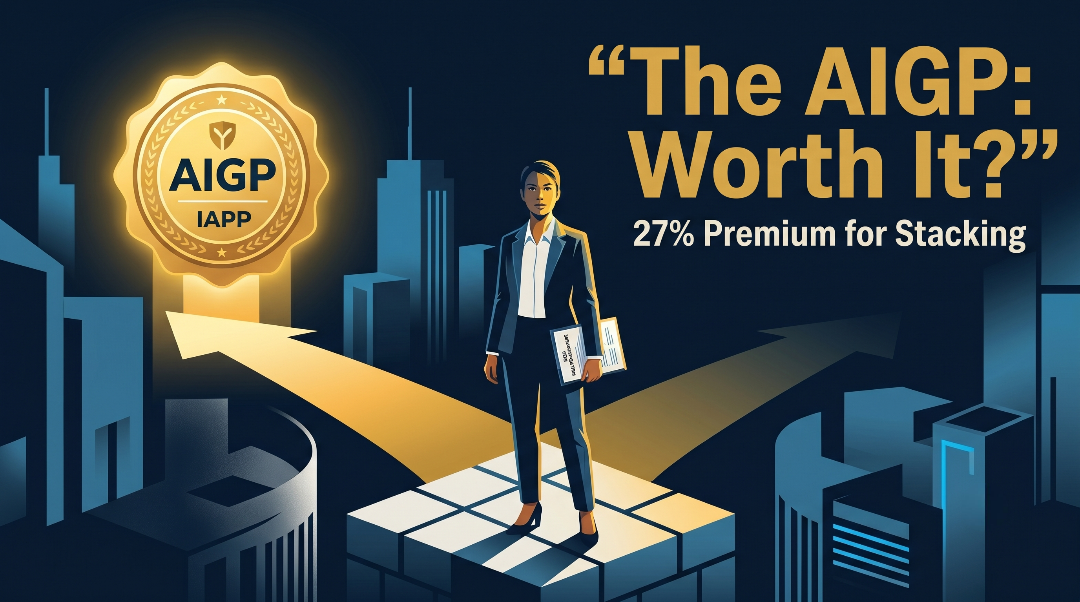
Is the AIGP Certification Worth It in 2026? An Honest Verdict From Someone Who Holds It
The AIGP certification is worth it for mid-to-senior compliance, privacy, risk, and product professionals in regulated industries who need to signal AI governance expertise to pivot or advance. It is not a career launcher for early-stage candidates or a substitute for applied experience. The real compensation premium comes from stacking the AIGP with an existing IAPP credential - professionals who hold multiple IAPP certifications earn 27% more than those with none, according to the IAPP 2025-26 AI Governance
TL;DR - Quick Summary
The AIGP certification is worth it in 2026 for mid-to-senior professionals in compliance, privacy, risk, or product roles in regulated industries who are pivoting into or advancing within AI governance - but only when paired with relevant experience and a concrete artifact showing applied judgment. It is not worth it as a standalone credential for early-career candidates or engineers expecting it to open doors on its own. According to the IAPP 2025-26 AI Governance Profession Report, holding multiple IAPP credentials correlates with a 27% salary premium over non-credentialed peers, making the stacking strategy - AIGP plus CIPP or CIPM - the stronger investment for most readers in this audience.
Enjoying this?
Get weekly AI governance insights and curated roles in your inbox.
Why the AIGP Question Matters in 2026
The AI Governance Professional (AIGP) credential through IAPP is now two years into wide market circulation, which means there is enough real hiring data to give you an honest answer about whether it moves the needle. According to PwC's AI Jobs Barometer 2025, demand for AI governance professionals grew 30% year over year, and Forrester projects that 60% of Fortune 100 companies will appoint a dedicated Head of AI Governance by the end of 2026. That demand surge is real. What is less clear - until you look at actual job postings and hiring patterns - is whether the AIGP is the credential that captures it.
The Axial Search January 2026 analysis of 146 U.S. AI governance job postings found that only 12% of roles explicitly name a required credential. That number surprises candidates who expect certification to be a gatekeeper. It is not. But the same IAPP 2025-26 data shows that 77% of working AI governance professionals hold at least one IAPP certification and 39% hold multiple. The credential is an accelerator, not a prerequisite - and going without one when most of the candidate pool has it puts you at a quiet disadvantage that does not show up in the job description.
The Real Challenge With Certification Decisions
The AI governance credential market is noisy. Every few months a new certification enters the conversation, and mid-to-senior professionals in compliance, privacy, and risk have limited time and real money to spend. The AIGP exam runs $649 to $799, and the official IAPP training adds another $995 to $1,195 on top of that. That is a legitimate investment decision, not a casual purchase.
The mistake most candidates make is treating the AIGP as a career transformer rather than a signal amplifier. It cannot substitute for experience. A candidate who holds the credential but cannot speak to a real governance framework in context - cannot describe how they structured a model risk assessment, how they mapped an AI use case to the EU AI Act, how they escalated a bias finding to an executive - still gets screened out in the first interview. What the AIGP does is give hiring managers a shared vocabulary and a signal of deliberate commitment to the field. For lateral movers who do not yet have an AI-titled role on their resume, that signal carries real weight. For everyone else, it needs something to stand on.
What the AIGP Actually Covers in 2026
The IAPP updated the AIGP Body of Knowledge to version 2.1, effective February 2, 2026. The update added coverage of agentic AI architectures - a material addition that reflects where enterprise AI deployment is actually heading. The current exam spans four domains:
- AI governance foundations - governance principles, organizational structures, roles and responsibilities
- Laws, standards, and frameworks - EU AI Act, NIST AI Risk Management Framework, ISO 42001, OECD AI Principles, and emerging U.S. state-level requirements
- AI development lifecycle governance - risk assessment, data governance, model documentation, bias and fairness evaluation
- Deployment and use governance - monitoring, incident response, vendor and third-party AI oversight, agentic system controls
There are no prerequisites to sit the exam. That accessibility is a genuine feature for experienced professionals who want to move fast, and it is a limitation for hiring managers who cannot use the credential alone to gauge depth of experience. It explains why the credential functions as a signal rather than a filter in most hiring decisions.
As someone who holds the AIGP alongside the Certified Cloud Security Professional (CCSP) through ISC2, I can tell you that the domain coverage maps well to what regulated industries actually need to govern - particularly the lifecycle and deployment domains, which address the gaps most compliance and privacy professionals carry when they enter AI governance work.
What the AIGP Signals to a Hiring Manager
When a hiring manager sees AIGP on a resume, three things register. First, the candidate made a deliberate investment in AI governance as a field - not AI broadly, not data science, but governance specifically. For roles that require cross-functional accountability - the AI Governance Lead, the AI Compliance Manager, the Director of AI Governance - that specificity matters. Second, the candidate has a working vocabulary for the frameworks and regulations the team is operating under. Onboarding gets shorter. Third, for lateral movers, it answers the implicit question: why do you want to do this work, and have you done the preparation to be credible on day one?
What the credential does not signal is applied judgment. According to The AI Governance Hub's recruiting practice observations, the candidates who convert in competitive searches are consistently the ones who pair the AIGP with one concrete artifact or story - a governance framework they built, a model risk assessment they led, a policy they wrote, a board presentation on AI risk they delivered. The credential gets you a closer read. The artifact closes the interview.
Browse current AI governance job listings and filter by compliance and risk to see how frequently governance credentials appear in mid-to-senior postings - the pattern is instructive.
The Stacking Strategy Is Where the Money Lives
The strongest compensation case for the AIGP is not the credential alone. According to the IAPP 2025-26 AI Governance Profession Report, holding one IAPP certification correlates with 13% higher pay, but holding multiple correlates with 27% higher pay. That gap is the stacking premium - and for most professionals in this audience, it is the right frame for the investment decision.
The Verifywise AI Governance Salary Report 2026 found that professionals who bridge privacy and AI governance earn a U.S. median of $169,700, compared to $151,800 for AI governance practitioners without the privacy background - a difference of roughly $18,000 per year. Adding a CIPP or CIPM credential to the AIGP captures that premium in a form hiring managers can see on a resume. That combination - AIGP plus CIPP/EU or AIGP plus CIPM - is the credential stack I see most consistently in candidates who close offers at the AI Governance Lead and Director levels.
AI Governance Lead
Base range: $150,000 to $210,000
Credential stack that performs: AIGP plus CIPP
Sector premium: Finance and healthcare pay 15-25% above baseline
Source: IAPP 2025-26, Axial Search January 2026
AI Compliance Manager
Mid-level range: $125,000 to $160,000
Senior range: $170,000 to $200,000
Credential stack that performs: AIGP plus CIPP or CIPM
Source: IAPP 2025-26, ZipRecruiter February 2026
The PwC AI Jobs Barometer 2025 data adds important context: AI governance skills already command a 56% salary premium over equivalent roles without AI governance scope. The AIGP does not create that premium - the market does. The credential helps you capture it by making your governance expertise legible to hiring managers at volume, before they ever speak to you.
Who Should Get the AIGP and Who Should Wait
Get it if:
- You are a mid-to-senior compliance, privacy, GRC, or product professional in finance, healthcare, or professional services who wants to move into or advance within AI governance
- You are a lateral mover without an AI-titled role yet and need a credential to anchor your pivot on a resume
- You already hold a CIPP, CIPM, or CISSP and want to add AI governance expertise in a structured, credentialed way
- Your organization is implementing the EU AI Act, NIST AI RMF, or ISO 42001 and you need the vocabulary to operate effectively in that work
Wait or skip if:
- You are early-career and lack the professional context to make the domain content land in interviews - experience is the prerequisite the exam does not require but the job does
- You are a software engineer or ML practitioner expecting the credential to signal technical depth - it does not, and you will be better served by NIST AI RMF implementation experience and a technical governance portfolio
- You have no governance work experience and no artifact to pair with the credential - the AIGP without a story to support it will not move a hiring manager who has candidates with both
Common Mistakes to Avoid
-
Treating the exam as the finish line. Candidates who earn the AIGP and stop there - no artifacts, no framework application, no concrete governance story - do not advance past phone screens in competitive searches. The credential opens the door. You still have to walk through it.
-
Buying training before assessing your baseline. The IAPP 2025-26 material is well-structured, but experienced compliance or privacy professionals often have more domain knowledge than they realize. Review the Body of Knowledge domains before committing to full training - you may need less prep than the official package assumes.
-
Ignoring the stacking math. Treating the AIGP as a standalone investment when the 27% premium requires multiple IAPP credentials is a common planning error. If you already hold a CIPP, adding the AIGP is a high-ROI decision. If you hold nothing, consider whether CIPP or CIPM is the right first credential for your background.
-
Waiting for the perfect moment. The AIGP Body of Knowledge is already on version 2.1. The exam evolves with the field. Candidates who delay because they want to feel fully ready often find themselves studying content that has already shifted. Experienced professionals in this audience have enough domain foundation to sit within 60 to 90 days of structured study.
-
Underselling the credential in interviews. The AIGP signals that you understand AI governance as a discipline - laws, frameworks, lifecycle risk, deployment controls. Candidates who mention the credential without connecting it to specific frameworks or use cases leave value on the table. Reference the EU AI Act or the NIST AI Risk Management Framework by name.
A Practical Action Plan
-
Audit your existing credentials this week. If you hold a CIPP, CIPM, or CISSP, map where your current knowledge base sits against the four AIGP domains. Identify gaps. This takes two hours and tells you whether you need official IAPP training or targeted self-study.
-
Download the AIGP Body of Knowledge v2.1 from IAPP. Read the domain descriptions before purchasing anything. If you can speak to 60% or more of the material from your current experience, you likely need 60 to 90 days of structured self-study, not the full training package.
-
Build one governance artifact in parallel with your study. A model risk assessment template, a vendor AI questionnaire, a board-level AI risk summary, or a written AI use case inventory. This is the artifact that supports the credential in interviews. Without it, the credential does the heavy lifting it cannot do.
-
Join the IAPP AI Governance community and engage for 30 days before your exam. Read the discussions. Comment on three threads. The vocabulary you absorb doing this will sharpen your performance on constructed-response questions more than additional practice exams.
-
Register for the exam only after you can answer this question cold: "Walk me through how you would assess an AI use case against the NIST AI RMF." If you can do that without notes, you are ready. If you cannot, study the Govern and Map functions of the NIST AI Risk Management Framework before sitting.
-
Plan your stack from day one. If you do not yet hold a CIPP or CIPM, map out whether it follows the AIGP or precedes it based on your current background. The stacking premium is not theoretical - it is $18,000 to $24,000 in annual compensation based on IAPP and Verifywise data. It deserves a plan.
-
Subscribe to The Governance Stack, our weekly AI governance briefing, to stay current on regulatory developments. The AIGP exam tests frameworks as they exist today - the job requires you to track them as they evolve.
Compensation Context
The market data makes the investment case concrete. According to the Axial Search January 2026 analysis of 146 U.S. AI governance postings, the median salary across all AI governance roles is $158,750, with the middle 80% of roles paying between $156,000 and $219,000. The IAPP 2025-26 data shows that 85% of AI governance positions target professionals with five or more years of experience - which maps precisely to the mid-to-senior audience for whom the AIGP makes the most sense.
The ManpowerGroup 2026 Talent Shortage Survey of 39,000 global employers found that 72% of employers report difficulty filling AI-related roles - the highest recorded talent shortage in any technology specialty. That shortage is what creates leverage for credentialed, experienced professionals. The AIGP, paired with a matching credential stack and demonstrable experience, positions you on the right side of a supply-demand imbalance that is not resolving quickly.
About the Author
Christopher L. Buford is an AI governance and security practitioner and founder of The AI Governance Hub, the only dedicated platform connecting AI governance, safety, security, and policy professionals with the organizations that need them. He holds the AI Governance Professional (AIGP) through IAPP, the Certified Cloud Security Professional (CCSP) through ISC2, and the Certificate of Cloud Security Knowledge (CCSK) through CSA. He has 25 years of hands-on enterprise technology experience and 16 years inside healthcare organizations including McKesson, Change Healthcare, and Children's Healthcare of Atlanta.
Frequently Asked Questions
Is the AIGP certification worth it in 2026?
Yes - for mid-to-senior compliance, privacy, risk, and product professionals in regulated industries who need to signal AI governance expertise for a pivot or promotion. The real ROI comes from stacking: holding multiple IAPP credentials correlates with a 27% salary premium versus none, according to the IAPP 2025-26 AI Governance Profession Report. For early-career candidates or technical engineers expecting it to serve as a career launcher on its own, the credential is unlikely to deliver that outcome without applied experience behind it.
What does the AIGP exam cover in 2026?
The AIGP Body of Knowledge version 2.1, effective February 2, 2026, spans four domains: AI governance foundations, laws and standards including the EU AI Act and NIST AI Risk Management Framework, AI development lifecycle governance, and deployment and use governance including agentic AI architectures. There are no prerequisites to sit the exam, and experienced compliance or privacy professionals typically need 60 to 90 days of structured study based on recruiting practice observations from The AI Governance Hub.
How much does the AIGP certification cost?
The AIGP exam fee runs $649 to $799 depending on IAPP membership status. The official IAPP training adds $995 to $1,195 on top of that. Experienced professionals with existing compliance, privacy, or GRC backgrounds should assess how much of the Body of Knowledge they already cover before committing to the full training package - many can pass with targeted self-study at lower cost.
Does the AIGP increase your salary?
It correlates with higher pay, but the premium comes from stacking rather than the AIGP alone. The IAPP 2025-26 AI Governance Profession Report shows that one IAPP certification correlates with 13% higher pay, while holding multiple correlates with 27% higher pay. The Verifywise AI Governance Salary Report 2026 found that professionals who combine privacy and AI governance expertise earn a U.S. median of $169,700 versus $151,800 for those without the privacy background - an $18,000 annual difference that an AIGP plus CIPP stack helps capture.
Do employers require the AIGP for AI governance roles?
Most do not explicitly require it. The Axial Search January 2026 analysis of 146 U.S. AI governance postings found that only 12% of roles specify a required credential. However, the IAPP 2025-26 data shows that 77% of working AI governance professionals hold at least one IAPP certification. The credential functions as an accelerator rather than a gatekeeper - it does not replace experience, but it gives hiring managers a signal of deliberate commitment that matters especially for candidates making lateral moves into AI governance without a prior AI-titled role.
Can I get into AI governance without the AIGP?
Yes, but mid-to-senior candidates competing against credentialed peers are at a quiet disadvantage that does not appear in the job description. According to The AI Governance Hub's recruiting practice observations, the candidates who close offers in competitive searches typically pair relevant experience with at least one governance-specific credential and a concrete artifact demonstrating applied judgment. For professionals in compliance, privacy, or GRC who are targeting AI Governance Lead or AI Compliance Manager roles, the AIGP combined with existing credentials is the most direct path to closing that gap. Browse current AI governance job listings to see the credential patterns across active postings.
Sources
IAPP. "AI Governance Profession Report 2025-26." iapp.org. Published 2025.
Axial Search. "AI Governance Job Market Analysis." axialsearch.com. Published January 2026.
PwC. "AI Jobs Barometer 2025." pwc.com. Published 2025.
Verifywise. "AI Governance Salary Report 2026." Published 2026.
ManpowerGroup. "Talent Shortage Survey 2026." manpowergroup.com. Published 2026.
Forrester. "AI Governance Appointments Forecast 2026." Published 2026.
Original recruiting analysis - The AI Governance Hub (theaigovernancehub.com), based on active talent practice placements and market observations, June 2026.
Subscribe to The Governance Stack
Weekly AI governance roles, regulation updates, and resources.
Looking for AI governance roles?
Browse open positions